Power tool safety on Pakistani sites comes down to three habits: protect your eyes, hands, lungs and feet; make sure the electricity feeding the tool is safe; and treat the angle grinder with more respect than anything else in the bag. Serious injuries usually follow the same script: a grinder running without its guard, a drill bit that jams and twists a wrist, or a machine plugged into a thin extension board on wiring with no earth.
Below are nine rules that prevent most of that, followed by the problems that are specific to working here: load shedding, voltage drops, 45°C summers, cement and marble dust, children at home and chappals on site.
Power Tool Safety: 9 Rules for Every Job
- Wear eye protection every time. Proper safety glasses or goggles, not sunglasses. A chip of concrete or a fragment of a disc moves faster than you can blink.
- Keep guards and side handles fitted. They come in the box for a reason. Removing the guard turns an ordinary kickback or a broken disc into a hospital visit.
- Unplug before changing a disc, bit or blade. On cordless tools, take the battery out. Releasing the trigger is not enough.
- Check the speed rating on every disc. The maximum RPM printed on a disc must be equal to or higher than the no-load speed of your grinder.
- Use an earthed socket protected by an RCD. Get an electrician to confirm the earth and fit a 30mA RCD (often sold as an ELCB or RCCB).
- Use two hands and stand out of line. Expect kickback and position your body so it pushes the tool away from you, not into your legs.
- Clamp the workpiece. Holding a pipe under your foot or a tile in your palm is how ankles and fingers get cut.
- Dress for the job. Closed shoes, sleeves buttoned or rolled, no loose dupatta or chadar near a spinning chuck, and long hair tied back.
- Switch off when the power goes. If load shedding hits mid-job, turn the tool off and release any lock-on button so it cannot restart by itself when the supply or generator comes back.
Protective Gear That Matches the Job
Safety gear does not need to be expensive, but it must suit the work. A cloth tied over the face does very little against the fine dust from cutting tiles, marble and concrete, and cotton gloves near a rotating drill bit can get wrapped up and pull your hand in.
| Job | Minimum protection | Why |
|---|---|---|
| Cutting or grinding metal | Goggles or face shield, leather gloves, ear plugs | Sparks, hot fragments and noise |
| Cutting tile, marble or concrete | Goggles, FFP2 or N95-type dust mask, ear plugs | Fine silica dust damages lungs over the years |
| Drilling brick and concrete | Safety glasses, dust mask when drilling overhead | Grit falls straight into your eyes |
| Circular saw and woodwork | Safety glasses, ear protection, no loose gloves | Flying chips, kickback and snagging |
| Every site job | Closed shoes or safety boots | Dropped tools, discs and debris |
Chappals are the default on many Pakistani sites, and they give zero protection against a dropped rotary hammer or a nail in the rubble. Closed shoes are the cheapest safety upgrade you can make.
Electrical Safety: Earthing, Extension Boards and Voltage
In many homes and half-built structures, the earth pin on the socket is not connected to anything. If a tool with a metal gear housing develops a fault, the current needs somewhere to go, and without an earth it can go through you. Ask a qualified electrician to test the earth and fit an RCD rated around 30mA; it cuts the supply in a fraction of a second if current starts leaking through a person. Tools marked with the double-square symbol are double insulated and do not depend on earth, but they still benefit from an RCD.
Extension boards cause more trouble than people expect:
- Use a heavy-duty board with thick copper cable, not a thin multi-plug meant for phone chargers.
- Unroll cable drums fully, because coiled cable heats up under a 1,000W-plus load.
- Run one heavy tool per board, not a rotary hammer and a heat gun together.
- Never use a two-pin adapter or push bare wires into a socket.
- Replace damaged cable instead of wrapping cuts in tape.
- Keep plugs and joints out of water, curing slurry and the cutting line.
Low voltage is a quiet tool killer. When the supply drops, a motor draws more current to keep going, runs hot and can burn its armature. If the lights dim or the tool sounds sluggish, stop and wait. On generator power, let the generator settle before plugging in and switch tools off before shutting it down. Check our warranty policy for how tool faults are handled.
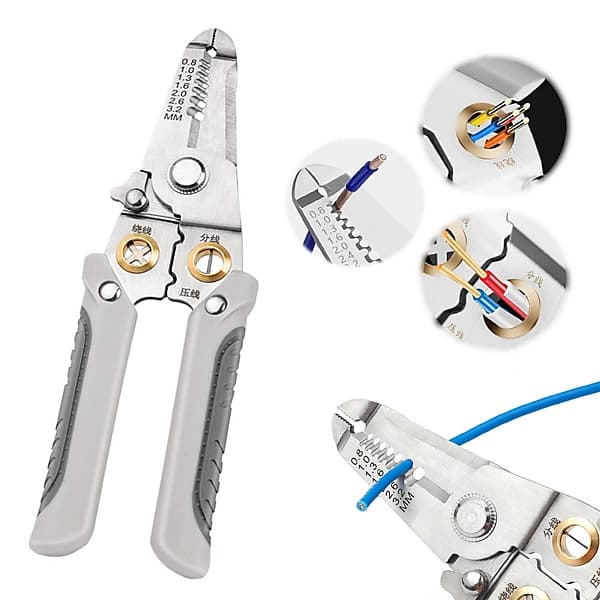
For wiring jobs, strip insulation with a proper stripper, not a knife or your teeth. The Multifunctional Wire Stripper and Cable Cutter (Rs 1,250) strips 0.8mm to 3.2mm wire cleanly. Rubber handle grips are there for comfort, not for working on live circuits: always switch off the breaker first.
Shop · wire stripper

Angle Grinder Safety Tips
Popular 4-inch grinders such as the Sared 0401 and the MAX 4 Inch Heavy Duty Angle Grinder run at 11,000 RPM with no load. At that speed a cracked disc becomes shrapnel, which is why these angle grinder safety tips matter more than anything else in this guide.
- Right disc, right job. Thin cutting discs are for cutting only. Grinding with the flat face of a cutting disc side-loads it and can shatter it.
- Right size. Never remove the guard to squeeze a 5-inch disc onto a 4-inch grinder. If you need 125mm discs, use a 125mm grinder such as the MAX 5 Inch Heavy Duty Angle Grinder with Rear Handle.
- Inspect the disc before fitting. Bonded discs carry an expiry date on the metal centre ring. Throw away discs that are expired, chipped, cracked, damp or have been dropped.
- Let it reach full speed before it touches the work, and let the disc do the cutting. Forcing it causes binding and kickback.
- Stand to the side of the cutting line with the guard between the disc and your body. Point sparks away from people, petrol, thinner, gas cylinders and sawdust.
- Wait for the disc to stop completely before putting the grinder down. A spinning disc can walk the tool across the floor.
- Aggressive wood discs, such as chain or carving discs, need the guard and side handle fitted, two hands on the tool and no plunge cuts.
Shop · angle grinder heavy duty

21V Brushless Cordless Angle Grinder | Heavy Duty Battery Grinder

MAX
MAX 5 Inch Heavy Duty Angle Grinder 125mm with Rear Handle | Professional Power Tool


Sared
Sared 0401 High-Power 4-Inch Angle Grinder - 850W Heavy Duty Electric Cutter & Grinder
Drill Machine Safety: Impact Drills and Rotary Hammers
The main drill machine hazard is the bit binding, whether it catches on rebar, a knot in timber or the far side of a steel sheet, and the whole tool twisting in your hand. A 13mm impact drill or a 26mm rotary hammer has enough torque to sprain a wrist or throw you off a ladder.
- Always fit and use the side handle. Most impact drills and rotary hammers include a 360-degree auxiliary handle.
- Avoid the lock-on button when working overhead or on a ladder. If the bit jams, you want the tool to stop the moment you let go.
- Before drilling a wall, think about what is inside it. Avoid drilling straight above or below switches and sockets, or in line with taps, where conduits and pipes usually run.
- On a ladder, work at chest height and never overreach. A cordless drill removes the cable trip hazard.
- Use the right machine. Large anchor holes in concrete are rotary hammer work, and forcing an impact drill overloads both tool and operator. Our rotary hammer vs impact drill guide explains the difference.
Heat, Dust and Load Shedding: Pakistan-Specific Hazards
Heat. At 45°C, motors run hotter, batteries age faster and people make more mistakes. Store tools in the shade, cool a hot corded tool by running it for 20 to 30 seconds with no load, and plan heavy cutting for early morning. Cordless users should also read our cordless battery care guide.
Dust. Cement, marble and brick dust clog motor vents, and a choked motor overheats. Blow out the vents regularly with goggles on; a Dartek 680W Electric Air Blower (Rs 7,300) clears a whole bag of tools in minutes. Where the tool and material allow, cut tiles and stone wet to keep the dust down.
Load shedding. Besides switching off (rule 9), never keep working by the light of a phone torch. The Cordless Power Tool LED Work Light (Rs 1,150) slides onto a 14.4V to 21V slide-on tool battery and floods the area with light. Most home UPS units are not built for heavy motor loads, so do not run a grinder or rotary hammer from one; wait for mains power or use a properly sized generator.
Workshop Safety at Home: Children, Storage and Upkeep
- Unplug the tool every time you step away, even for a minute.
- Remove batteries from cordless tools and store them separately.
- Keep discs, bits and blades in a closed box out of reach. Children love picking up shiny drill bits.
- Store discs flat and dry, because moisture weakens bonded discs.
- Check cables and plugs every month. Heavy sparking at the motor brushes, a burning smell or a body that gets too hot to hold are signs the tool needs service.
- Know where your main breaker is and keep a basic first-aid kit nearby.
Common Safety Mistakes on Pakistani Sites
| Mistake | Why it is dangerous | Do this instead |
|---|---|---|
| Guard removed to fit a bigger disc | Disc fragments fly at the operator | Use a grinder sized for the disc |
| Holding tiles or pipes with a foot | The disc slips into skin | Clamp the work or use a stand |
| Bare wires pushed into a socket | No earth, arcing, loose contact | Fit a proper three-pin plug |
| Cloth over the face for marble dust | Fine dust passes straight through | Particulate mask and wet cutting |
| Working in chappals | Dropped tools and debris | Closed shoes or safety boots |
| Lock-on left engaged in load shedding | Tool restarts when power returns | Switch off and release the lock |
| One thin extension board for everything | Overheating and fire risk | Heavy-duty board, one heavy tool |
Safer Tools and Accessories Worth Buying
If you cut metal or tile regularly, a stand is the biggest safety upgrade you can buy. The Universal Angle Grinder Base Bracket with Safety Guard (Rs 1,400) gives a 4-inch grinder a flat base, depth control and a shield over the disc. For pipes, rods and angle iron, the Sliding Angle Grinder Stand with Vise Clamp (Rs 7,000) clamps the work so your hand never goes near the disc. More options are in our angle grinder attachments guide.
Shop · cutting stand


For the grinder itself, the MAX 4 Inch (Rs 7,100) comes with a protective wheel guard and a 2-position side handle, the Sared 0401 (Rs 4,800) is the budget 850W pick, and the MAX 5 Inch (Rs 10,700) adds a rear handle for better control on heavy cuts. Good power tool safety starts with the right tool: read the manual once and keep every guard on.